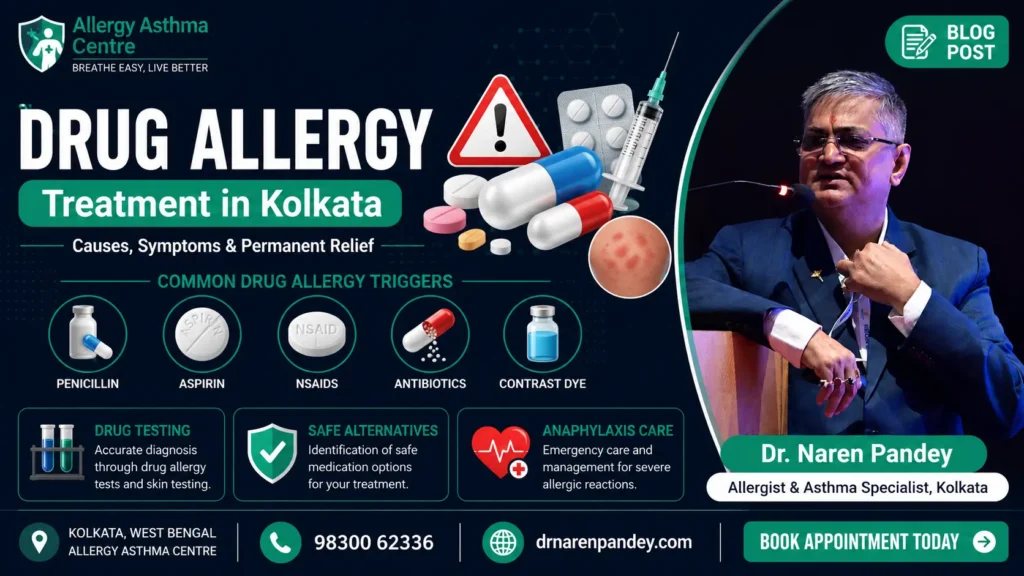
Drug Allergy Treatment in Kolkata: Causes, Symptoms & Permanent Relief | Dr. Naren Pandey
By Dr. Naren Pandey | Allergist & Asthma Specialist, Kolkata
Have you ever taken a medication and suddenly developed a rash, hives, or difficulty breathing? Or perhaps your doctor has told you that you are “allergic to penicillin” — but you are not sure what that means or what to do about it? You may be experiencing a drug allergy — a serious yet often misunderstood condition that requires expert diagnosis and management.
At the Allergy Asthma Centre, Dr. Naren Pandey has extensive experience in diagnosing and managing drug allergy in patients across Kolkata. This complete guide explains what drug allergy is, which medications commonly cause it, how to get tested, and how to stay safe.
What Is Drug Allergy?
Drug allergy is an immune system reaction to a medication. The immune system mistakenly identifies the drug as a harmful substance and produces antibodies against it. The next time the same medication is taken, these antibodies trigger an allergic reaction.
Drug allergy is different from:
Side effects — predictable, dose-dependent reactions listed on the medication label (e.g., nausea from antibiotics)
Drug intolerance — sensitivity to a drug that does not involve the immune system (e.g., stomach upset from aspirin)
Drug toxicity — harm caused by too much of a drug
True drug allergy involves the immune system and can cause reactions ranging from mild skin rashes to life-threatening anaphylaxis.
Common Drug Allergies in Kolkata
Any medication can potentially cause an allergic reaction, but these are the most common culprits seen at our clinic:
Antibiotics
- Penicillin and amoxicillin — the most common cause of drug allergy worldwide
- Cephalosporins — cross-react with penicillin in some patients
- Sulfonamides (sulfa drugs) — common cause of skin reactions
- Fluoroquinolones (ciprofloxacin, levofloxacin)
Pain Relievers and Anti-Inflammatory Drugs
- Aspirin — can trigger urticaria, asthma, and anaphylaxis
- NSAIDs (ibuprofen, diclofenac, naproxen) — very common in Kolkata
- Paracetamol — rare but possible
Other Common Culprits
- ACE inhibitors (enalapril, ramipril) — cause angioedema and cough
- Contrast dyes used in CT scans and X-rays
- Local anaesthetics used in dental procedures
- Insulin — particularly older animal-derived formulations
- Chemotherapy drugs
- Anticonvulsants (carbamazepine, phenytoin)
Symptoms of Drug Allergy
Drug allergy symptoms can appear within minutes to hours of taking the medication — or sometimes days later:
Mild to Moderate Symptoms:
- Skin rash — flat, red patches on the body
- Urticaria (hives) — raised, itchy welts that can appear anywhere
- Itching — generalised or localised
- Runny nose and watery eyes
- Fever
Serious Symptoms:
- Angioedema — swelling of the face, lips, tongue, or throat
- Wheezing or difficulty breathing
- Rapid heart rate
- Drop in blood pressure
- Dizziness or fainting
⚠️ Anaphylaxis — Medical Emergency:
- Sudden throat tightening
- Severe breathing difficulty
- Loss of consciousness
- Seek emergency care immediately
Serum Sickness (delayed reaction — 7–21 days after medication):
- Fever
- Joint pain
- Skin rash
- Swollen lymph nodes
Stevens-Johnson Syndrome (SJS) — serious skin reaction:
- Painful blistering of skin and mucous membranes
- Requires immediate hospitalisation
- Most commonly caused by sulfa antibiotics, anticonvulsants
Drug Allergy vs Drug Side Effect: Know the Difference
| Feature | Drug Allergy | Drug Side Effect |
|---|---|---|
| Immune system involved | Yes | No |
| Dose dependent | No — even tiny amounts trigger | Yes — higher doses = worse effects |
| Predictable | No | Yes — listed on label |
| Symptoms | Rash, hives, anaphylaxis | Nausea, drowsiness, etc. |
| Timing | Variable — minutes to weeks | Usually soon after taking |
| Management | Avoid drug permanently | Reduce dose or change timing |
How Is Drug Allergy Diagnosed in Kolkata?
Drug allergy diagnosis requires careful evaluation by an experienced allergist. At Allergy Asthma Centre, Dr. Naren Pandey uses the following approach:
1. Detailed Drug History A thorough review of all medications taken — prescription, over-the-counter, herbal, and supplements. The timing of the reaction in relation to medication use is critical for diagnosis.
2. Skin Testing for Drug Allergy For selected drugs — particularly penicillin — skin testing can confirm or rule out IgE-mediated allergy.
- Skin prick test — a small amount of the drug is applied to the skin
- Intradermal test — a tiny amount is injected into the skin
- Results in 15–20 minutes
3. Specific IgE Blood Test Available for selected drugs — including penicillin, amoxicillin, and some other medications. Measures drug-specific IgE antibodies in the blood.
4. Drug Provocation Test (Oral Challenge) The gold standard for drug allergy diagnosis. The suspected drug is given in small, gradually increasing doses under close medical supervision.
This test is used to:
- Confirm or rule out drug allergy definitively
- Identify safe alternative medications
- De-label patients incorrectly labeled as “penicillin allergic”
⚠️ Drug provocation testing is done only in a clinical setting with emergency equipment — never attempt at home.
The Problem of “Penicillin Allergy” Labelling in Kolkata
One of the most common issues Dr. Naren Pandey sees in Kolkata patients is incorrect penicillin allergy labelling.
Many patients are told they are “allergic to penicillin” based on a childhood reaction — often a rash that may have been a viral rash, not a true drug allergy. Studies show that up to 90% of patients labeled as penicillin allergic can actually tolerate penicillin safely when properly tested.
This matters because:
- Penicillin is often the most effective and affordable antibiotic
- Penicillin-allergic patients are prescribed broader-spectrum antibiotics — contributing to antibiotic resistance
- A simple drug challenge test can confirm or clear the allergy label
If you have been told you are allergic to penicillin, Dr. Naren Pandey recommends getting formally tested — you may be unnecessarily avoiding a vital medication.
Drug Allergy Treatment in Kolkata
1. Immediate Treatment of Allergic Reaction
For mild reactions (rash, hives):
- Antihistamines — cetirizine, loratadine
- Topical steroid creams for skin rash
- Discontinue the offending drug immediately
For moderate reactions (angioedema, wheezing):
- Oral or injectable corticosteroids
- Bronchodilators for breathing difficulty
- Medical supervision required
For anaphylaxis:
- Epinephrine (adrenaline) injection — first line treatment
- Emergency hospitalisation
- Dr. Naren Pandey provides anaphylaxis action plans for high-risk patients
2. Drug Avoidance
Once a drug allergy is confirmed:
- The offending drug must be avoided permanently
- All treating doctors, dentists, and hospital staff must be informed
- Wear a medical alert bracelet identifying the drug allergy
- Keep an updated medication allergy list
3. Alternative Medications
Dr. Naren Pandey works with your treating physician to identify safe alternative medications. For example:
- Penicillin allergy → safe alternatives identified through testing
- NSAID allergy → paracetamol is usually well-tolerated
- ACE inhibitor allergy → ARBs (angiotensin receptor blockers) as alternative
4. Drug Desensitisation
For patients who are allergic to a medication but have no safe alternative — drug desensitisation may be performed:
- The drug is given in tiny, gradually increasing doses under strict medical supervision
- The immune system is temporarily tolerised to the drug
- Allows the patient to complete a necessary course of treatment
- Requires hospitalisation and specialist supervision
Drug desensitisation is available at Allergy Asthma Centre, Kolkata for selected cases.
How to Stay Safe with Drug Allergy
Always tell your doctor:
- Every medication you are allergic to
- What reaction you had (rash, breathing difficulty, anaphylaxis)
- When the reaction happened
Carry emergency medication:
- If you have had anaphylaxis — always carry an epinephrine auto-injector (EpiPen)
- Always carry antihistamines
Medical records:
- Keep a written record of all drug allergies
- Share with every doctor, dentist, or hospital you visit
Before any procedure:
- Tell your anaesthetist about all drug allergies before surgery
- Inform your dentist before any dental procedure
Get properly tested:
- Don’t assume you are allergic to a drug based on one childhood reaction
- Get formally tested by Dr. Naren Pandey — you may be able to safely use important medications
When Should You See Dr. Naren Pandey?
Consult us at Allergy Asthma Centre if:
- You have had a reaction to any medication
- You have been told you are “allergic to penicillin” and want to confirm
- You need a medication you may be allergic to — for a serious condition
- You have had anaphylaxis from a drug in the past
- You want an anaphylaxis action plan
For complete allergy treatment information, visit our Allergy Treatment in Kolkata page.
Also read:
- Blood Allergy Test in Kolkata
- Skin Prick Test in Kolkata
- Urticaria Treatment in Kolkata
- Immunotherapy in Kolkata
Watch: Drug Allergy Explained by Dr. Naren Pandey
[Embed YouTube video: https://youtu.be/tfAqMwaO0G0]
Book Your Appointment
Allergy Asthma Centre 2/2A Dr. Suresh Sarkar Road, Kolkata – 700014 📞 +91 98300 62336 🕘 Monday – Saturday: 9:00 AM – 7:00 PM 🌐 drnarenpandey.com
Don’t ignore drug allergy. Get properly tested and stay safe with expert guidance from Dr. Naren Pandey.