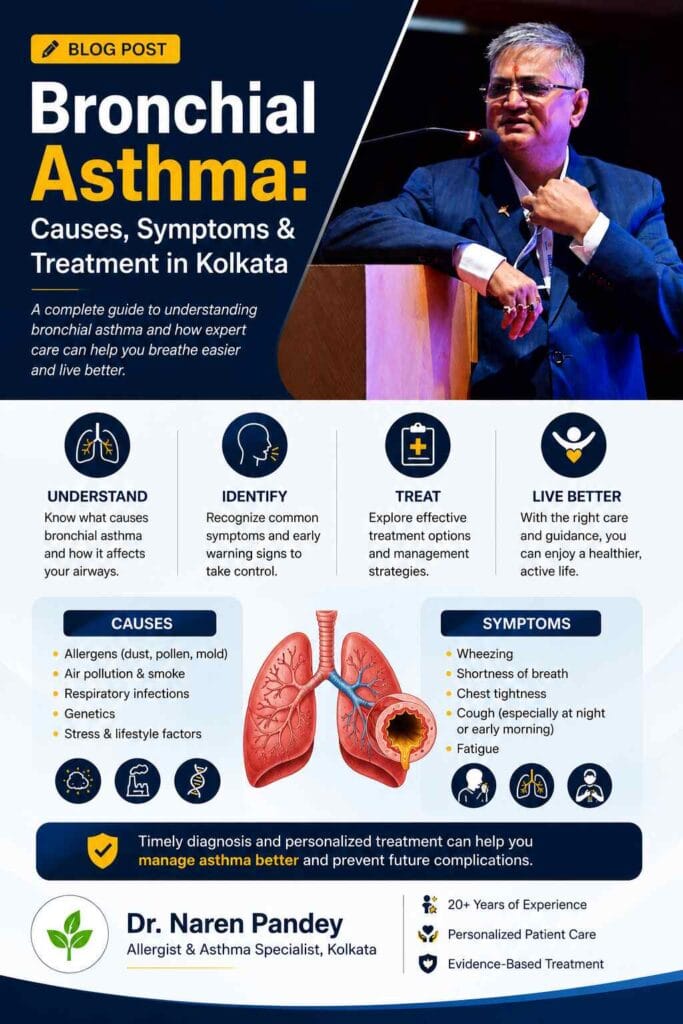
Bronchial Asthma: Causes, Symptoms & Treatment in Kolkata | Dr. Naren Pandey
By Dr. Naren Pandey | Allergist & Asthma Specialist, Kolkata
Do you wake up at night struggling to breathe? Does your chest feel tight and heavy in the morning? Do you hear a whistling sound when you breathe out? These are the classic signs of Bronchial Asthma — one of the most common chronic respiratory conditions affecting millions of people across India, including a large number of patients in Kolkata.
At the Allergy Asthma Centre, Dr. Naren Pandey has successfully treated thousands of bronchial asthma patients in Kolkata — helping them breathe freely without lifelong dependence on inhalers. This complete guide explains what bronchial asthma is, what causes it, and how to treat it effectively.
What Is Bronchial Asthma?
Bronchial asthma is a chronic inflammatory disease of the bronchial tubes — the airways that carry air in and out of the lungs. In asthma, these airways become:
- Inflamed — swollen and irritated
- Narrowed — making it harder for air to pass through
- Blocked with mucus — causing coughing and wheezing
This combination makes breathing extremely difficult — especially during an asthma attack.
The term “bronchial” refers to the bronchi — the large airways of the lungs. Bronchial asthma is the most common form of asthma and is what most people mean when they say “asthma.”
Types of Bronchial Asthma
Allergic Bronchial Asthma The most common type — triggered by allergens like dust mites, pollen, mold, and pet dander. The immune system overreacts to these harmless substances, causing airway inflammation. This is the type most effectively treated with immunotherapy.
Non-Allergic Bronchial Asthma Triggered by non-allergic factors like respiratory infections, cold air, exercise, stress, or chemical fumes. Less common than allergic asthma.
Occupational Asthma Caused by workplace allergens or irritants — common in workers exposed to flour dust, chemical fumes, or industrial gases.
Exercise-Induced Bronchospasm Airways narrow during or after physical exercise — causing breathlessness and chest tightness.
Childhood Asthma Bronchial asthma is one of the most common chronic conditions in children — often triggered by dust mites, cockroach allergens, and respiratory infections.
Causes of Bronchial Asthma in Kolkata
Kolkata’s environment makes it particularly high-risk for bronchial asthma:
Allergic Triggers
- House dust mites — thrive in Kolkata’s humid climate
- Cockroach droppings — major allergen in urban homes
- Mold and fungal spores — especially during monsoon
- Pollen — from roadside trees during spring
- Pet dander — from cats, dogs, and birds
Environmental Triggers
- Air pollution — vehicle exhaust and industrial emissions
- Construction dust — from ongoing urban development
- Cigarette smoke — active and passive
- Strong perfumes and chemical fumes
- Cold or dry air — especially during winter mornings
Genetic Factors
- Family history of asthma or allergy significantly increases risk
- If both parents have asthma, the child has a 70% chance of developing it
Symptoms of Bronchial Asthma
Bronchial asthma symptoms vary in severity — from mild to life-threatening:
Common Symptoms:
- Wheezing — a high-pitched whistling sound when breathing out
- Shortness of breath — feeling breathless even at rest
- Chest tightness — a feeling of pressure or squeezing in the chest
- Persistent cough — especially at night and early morning
- Difficulty sleeping due to breathlessness or coughing
Warning Signs of a Severe Asthma Attack:
- Extreme breathlessness — unable to complete a sentence
- Bluish lips or fingernails (cyanosis)
- Rapid breathing with no improvement from inhaler
- Confusion or drowsiness
Seek emergency medical care immediately if these symptoms appear.
Symptoms That Suggest Allergic Asthma:
- Symptoms worsen indoors — especially in the bedroom
- Worse in the morning and late evening
- Better when away from home or during holidays
- Associated with sneezing, runny nose, or itchy eyes
How Is Bronchial Asthma Diagnosed?
At Allergy Asthma Centre, Dr. Naren Pandey uses a comprehensive diagnostic approach:
Spirometry (Lung Function Test) The most important test for bronchial asthma. Spirometry measures:
- FEV1 — how much air you can breathe out in 1 second
- FVC — total air you can breathe out
- FEV1/FVC ratio — confirms airway obstruction
A significant improvement after bronchodilator confirms asthma. This test is available in-house at our Kolkata clinic.
Peak Flow Measurement Measures the speed of air coming out of your lungs. Regular peak flow monitoring helps track asthma severity and control.
Skin Prick Test (SPT) Identifies the specific allergen triggering your asthma — dust mites, pollen, mold, or cockroach. This is critical for allergic asthma because treating the underlying allergy often controls asthma permanently.
Chest X-Ray Rules out other lung conditions like pneumonia, COPD, or tuberculosis that may mimic asthma.
FeNO Test (Fractional Exhaled Nitric Oxide) Measures airway inflammation — helps confirm allergic asthma and guides steroid therapy.
Bronchial Asthma Treatment in Kolkata
1. Allergen Identification and Avoidance
For allergic bronchial asthma, identifying and avoiding the trigger is the first step. After skin prick testing, Dr. Naren Pandey creates a personalised avoidance plan:
- Dust-mite proof mattress and pillow covers
- HEPA air purifiers in bedroom
- Monthly AC filter cleaning
- Cockroach control measures
- Avoiding outdoor exposure during high pollen hours
2. Reliever Medications (Quick Relief)
Short-Acting Beta-Agonists (SABAs)
- Salbutamol (Ventolin) inhaler — opens airways within minutes
- Used during acute asthma attacks for immediate relief
- Should not be needed more than twice a week — if so, controller medication is needed
3. Controller Medications (Long-term Control)
Inhaled Corticosteroids (ICS)
- Most effective controller medication for bronchial asthma
- Reduces airway inflammation over time
- Must be used regularly even when symptoms are absent
Long-Acting Beta-Agonists (LABAs)
- Combined with ICS for moderate to severe asthma
- Keep airways open for 12 hours
Leukotriene Receptor Antagonists
- Particularly effective for allergic asthma and exercise-induced bronchospasm
- Available as tablets — useful for patients who struggle with inhalers
4. Allergy Immunotherapy — Permanent Relief for Allergic Asthma
For patients with allergic bronchial asthma, immunotherapy is the only treatment that addresses the root cause — not just the symptoms.
Under Dr. Naren Pandey’s expert supervision:
- The specific allergen (e.g., dust mite extract) is administered in gradually increasing doses
- The immune system learns to tolerate the allergen over time
- Airway inflammation reduces significantly
- Asthma symptoms decrease — often permanently
- Inhaler use is dramatically reduced
Immunotherapy is especially recommended for:
- Patients whose asthma is triggered by an identified allergen
- Those who need daily reliever inhalers
- Patients wanting to reduce or stop medication permanently
- Children with allergic asthma — early treatment prevents worsening
“Bronchial asthma is a manageable condition — but only if treated correctly. Most of my patients come using inhalers daily for years without knowing their trigger allergen. Once we identify the allergen and start immunotherapy, many achieve permanent relief.” — Dr. Naren Pandey, Allergy Asthma Centre, Kolkata
Bronchial Asthma vs COPD: Key Differences
Many patients in Kolkata confuse asthma with COPD (Chronic Obstructive Pulmonary Disease):
| Feature | Bronchial Asthma | COPD |
|---|---|---|
| Age of onset | Any age, often childhood | Usually 40+ years |
| Cause | Allergy, immune system | Smoking, pollution |
| Reversibility | Fully reversible | Partially reversible |
| Symptoms | Episodic, variable | Persistent, progressive |
| Treatment | Immunotherapy possible | No cure, only control |
| Spirometry | Normal between attacks | Always abnormal |
Accurate diagnosis is essential — the wrong treatment wastes years and money.
Living With Bronchial Asthma in Kolkata: Practical Tips
- Know your triggers — keep a symptom diary
- Always carry your reliever inhaler — even during good periods
- Get an allergy test — identify your exact trigger
- Clean AC filters monthly — dirty filters spread dust mite particles
- Avoid early morning outdoor exercise — pollution and pollen highest at dawn
- Get flu vaccination every year — respiratory infections are the #1 asthma trigger
- Monitor peak flow regularly — early warning of worsening control
- Never stop controller medication suddenly — always consult Dr. Naren Pandey first
When Should You See Dr. Naren Pandey?
Consult us at Allergy Asthma Centre if:
- You use a reliever inhaler more than twice a week
- Asthma wakes you up at night
- Your symptoms are worsening despite medication
- You have never had a proper allergy test for your asthma
- You want to reduce or stop inhaler use permanently
- Your child has been diagnosed with asthma
For complete allergy and asthma treatment information, visit our Allergy Treatment in Kolkata page.
Also read: Asthma Treatment in Kolkata
Watch: Bronchial Asthma Explained by Dr. Naren Pandey
[Embed YouTube video: https://youtu.be/gs61clKNuAY]
Book Your Appointment
Allergy Asthma Centre 2/2A Dr. Suresh Sarkar Road, Kolkata – 700014 📞 +91 98300 62336 🕘 Monday – Saturday: 9:00 AM – 7:00 PM 🌐 drnarenpandey.com
Breathe freely. Live fully. Get permanent relief from bronchial asthma today.