Allergic Rhinitis and Asthma: The Hidden Connection | Dr. Naren Pandey, Kolkata
By Dr. Naren Pandey | Allergist & Asthma Specialist, Kolkata
Do you sneeze repeatedly every morning? Does your nose run or feel blocked throughout the day? Do your eyes itch and water constantly? Most people in Kolkata dismiss these symptoms as “a frequent cold” or “seasonal problem” — and take an antihistamine tablet without consulting a doctor.
But here is what most people do not know: untreated allergic rhinitis is one of the most important risk factors for developing bronchial asthma.
At the Allergy Asthma Centre, Dr. Naren Pandey regularly sees patients who developed asthma after years of ignoring their nasal allergy symptoms. This guide explains the critical connection between allergic rhinitis and asthma — and why early treatment can prevent a lifetime of breathing problems.
What Is Allergic Rhinitis?
Allergic rhinitis — known in Bengali as নাকের এলার্জি — is an inflammation of the nasal passages caused by an allergic reaction to airborne substances like dust mites, pollen, mold, or cockroach allergens.
Common symptoms of allergic rhinitis:
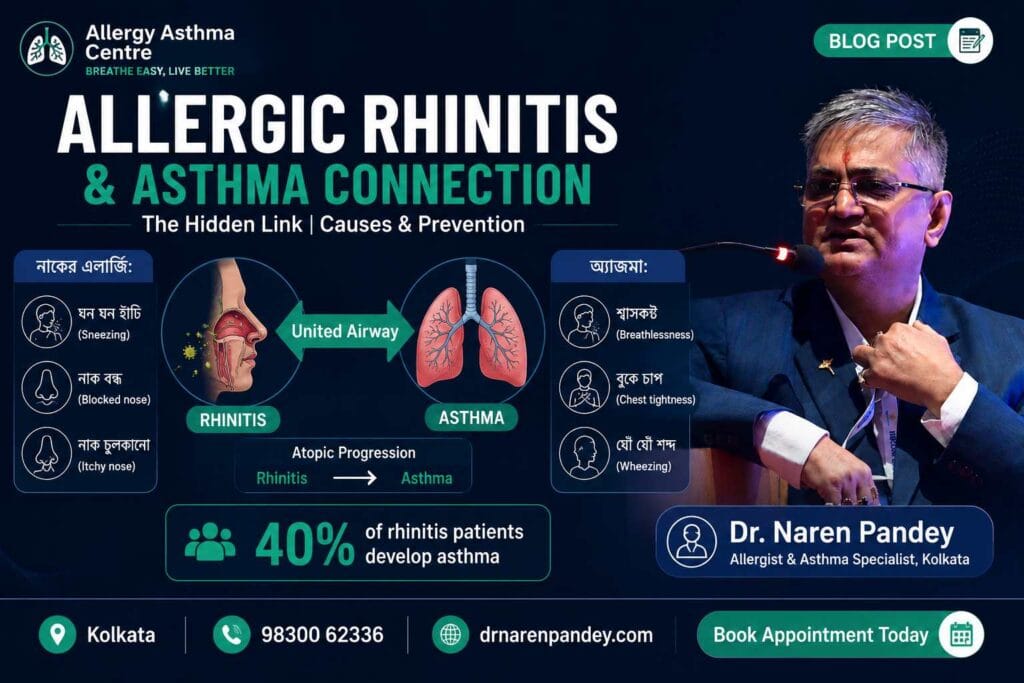
- ঘন ঘন হাঁচি (repeated sneezing) — especially in the morning
- নাক বন্ধ (blocked nose) — difficulty breathing through the nose
- নাক দিয়ে জল পড়া (runny nose) — thin, watery discharge
- নাক ও চোখ চুলকানো (itchy nose and eyes)
- চোখ দিয়ে জল পড়া (watery eyes)
- গলায় সুড়সুড়ি (throat tickling) — post-nasal drip
Many patients in Kolkata suffer from these symptoms for years — thinking it is a “frequent cold” — when it is actually allergic rhinitis that needs proper diagnosis and treatment.
What Is the Connection Between Allergic Rhinitis and Asthma?
The nose and the lungs are connected parts of the same respiratory system. Medical science now recognises this as the “United Airway Disease” concept — meaning that inflammation in the upper airway (nose) and lower airway (lungs) are interconnected and influence each other.
Here is how allergic rhinitis leads to asthma:
Step 1: Allergen (dust mite, pollen) enters the nose → triggers allergic inflammation in the nasal passages → allergic rhinitis develops.
Step 2: Inflammatory cells and chemicals from the nasal passages travel down to the bronchial tubes (airways in the lungs).
Step 3: Chronic inflammation gradually affects the bronchial tubes → airways become swollen, narrow, and reactive.
Step 4: The bronchial tubes overreact to triggers like cold air, exercise, or infection → causing wheezing, breathlessness, and chest tightness — bronchial asthma.
This progression — from nasal allergy to asthma — is called the “Atopic March” and it is extremely common in Kolkata patients.
Statistics: How Common Is This Connection?
The research is clear:
- Up to 40% of patients with allergic rhinitis develop asthma if left untreated
- 80–90% of asthma patients also have allergic rhinitis
- Treating allergic rhinitis effectively reduces the risk of asthma development significantly
- Immunotherapy for allergic rhinitis can prevent asthma from developing in children
These numbers highlight a critical message: allergic rhinitis is not just a “nuisance condition” — it is a serious medical condition that requires proper treatment.
Warning Signs: Is Your Rhinitis Becoming Asthma?
Watch for these warning signs that suggest allergic rhinitis is progressing to asthma:
| Warning Sign | What It Means |
|---|---|
| Cough that worsens at night | Airway inflammation extending to lungs |
| Chest tightness in the morning | Early bronchospasm |
| Shortness of breath with exercise | Exercise-induced bronchospasm |
| Wheezing — whistling sound when breathing | Airway narrowing |
| Breathlessness without exertion | Significant airway inflammation |
| Frequent respiratory infections | Compromised airway defence |
If you have allergic rhinitis AND any of the above symptoms — see Dr. Naren Pandey immediately. Early intervention can stop asthma from developing.
Why Is This Connection So Common in Kolkata?
Kolkata’s environment makes the rhinitis-to-asthma progression particularly common:
House dust mites — Kolkata’s high humidity (70–90% during monsoon) creates ideal conditions for dust mite growth. Dust mites are the #1 cause of both allergic rhinitis and allergic asthma in Kolkata.
Air pollution — Vehicle exhaust and industrial emissions irritate the respiratory mucosa — making both nasal passages and airways more reactive.
Cockroach allergens — Highly prevalent in Kolkata urban homes — a major trigger for both rhinitis and asthma.
Monsoon mold — Fungal spores peak during June–September — worsening both rhinitis and asthma symptoms.
Seasonal pollen — Spring pollen from roadside trees affects both the nose and lungs simultaneously.
How Is the Rhinitis-Asthma Connection Diagnosed?
At Allergy Asthma Centre, Dr. Naren Pandey uses a comprehensive approach:
1. Detailed Clinical History Assessment of both nasal and respiratory symptoms — their pattern, triggers, timing, and severity.
2. Skin Prick Test Identifies the specific allergen causing both rhinitis and asthma. Results in 20 minutes. This is the most critical diagnostic step — treatment must target the identified allergen.
3. Spirometry (Lung Function Test) Measures airway obstruction — confirms whether asthma has developed. Available in-house at our Kolkata clinic.
4. Nasal Examination Assessment of nasal passages — looking for polyps, deviated septum, or other structural problems.
5. IgE Blood Test Measures total and specific IgE levels — confirms allergic sensitisation.
Treatment: Managing Both Rhinitis and Asthma Together
The most effective approach treats both conditions simultaneously — because they share the same underlying immune mechanism.
1. Allergen Avoidance
Once the trigger allergen is identified, practical avoidance measures are implemented for both rhinitis and asthma:
- Dust-mite proof mattress and pillow covers
- HEPA air purifier in bedroom
- Monthly AC filter cleaning
- Cockroach control measures
- Avoiding outdoor exposure during high pollen hours
2. Medications for Rhinitis
- Nasal corticosteroid sprays — most effective for nasal symptoms; also reduces lower airway inflammation
- Antihistamines — reduces sneezing, itching, and runny nose
- Saline nasal rinse — removes allergens from nasal passages
3. Medications for Asthma
- Reliever inhalers — salbutamol for acute breathlessness
- Controller inhalers — inhaled corticosteroids for daily airway management
- Leukotriene inhibitors — particularly effective when both rhinitis and asthma are present
4. Allergy Immunotherapy — Treating Both Together
This is the most important treatment for patients with both allergic rhinitis and asthma.
Allergy immunotherapy — available at Allergy Asthma Centre, Kolkata — targets the root cause of both conditions simultaneously:
- Desensitises the immune system to the trigger allergen
- Reduces nasal inflammation — improving rhinitis symptoms
- Reduces airway inflammation — improving asthma control
- Prevents rhinitis from progressing to asthma — in early cases
- Provides long-term, permanent relief from both conditions
Studies show that immunotherapy for allergic rhinitis reduces the risk of asthma development by up to 50% in children and adults.
“I always tell my patients — if you have allergic rhinitis, treat it seriously. Every year of untreated rhinitis increases your risk of developing asthma. But with the right treatment, we can prevent that progression entirely.” — Dr. Naren Pandey, Allergy Asthma Centre, Kolkata
Rhinitis and Asthma in Children — Extra Caution Needed
Children with allergic rhinitis are at particularly high risk of developing asthma. In Kolkata, many parents are told their child has “frequent colds” — when the child actually has allergic rhinitis that is silently damaging their airways.
Signs in children that should not be ignored:
- Sneezing every morning before school
- Blocked nose causing mouth breathing and poor sleep
- Reduced concentration in class due to nasal symptoms
- Cough that worsens at night or with exercise
- Any wheezing or breathing difficulty
Early immunotherapy in children is the most effective strategy — preventing rhinitis from becoming lifelong asthma.
Read our complete guide: Child Allergy Doctor in Kolkata
Practical Tips for Rhinitis and Asthma Patients in Kolkata
- Morning routine — rinse nose with saline spray before getting out of bed
- Bedroom first — dust mites live in mattresses; allergen-proof covers are essential
- Keep windows closed during high pollution hours (8–10 AM peak traffic)
- AC maintenance — clean filters monthly; dirty filters circulate allergens
- Avoid cold air exposure — cold air triggers both rhinitis and asthma
- Monsoon precautions — fix damp walls, use dehumidifier, avoid outdoor exposure during mold peak
- Get allergy tested — knowing your exact trigger is the most important step
When to See Dr. Naren Pandey
Consult us at Allergy Asthma Centre if:
- You have nasal symptoms (sneezing, blocked nose) for more than 2 weeks
- You also have cough, wheeze, or chest tightness
- You have been diagnosed with rhinitis and want to prevent asthma
- Your child has frequent “colds” that never fully resolve
- Antihistamines help temporarily but symptoms keep coming back
- You want permanent relief through immunotherapy
For complete allergic rhinitis information: Allergic Rhinitis Treatment in Kolkata
For complete asthma information: Asthma Treatment in Kolkata
Also read:
Watch: Allergic Rhinitis & Asthma Explained by Dr. Naren Pandey
[Embed YouTube video: https://youtu.be/IzKdAmrl7gI]
Book Your Appointment
Allergy Asthma Centre 2/2A Dr. Suresh Sarkar Road, Kolkata – 700014 📞 +91 98300 62336 🕘 Monday – Saturday: 9:00 AM – 7:00 PM 🌐 drnarenpandey.com
Don’t let nasal allergy become asthma. Get tested and treated early — before it’s too late.