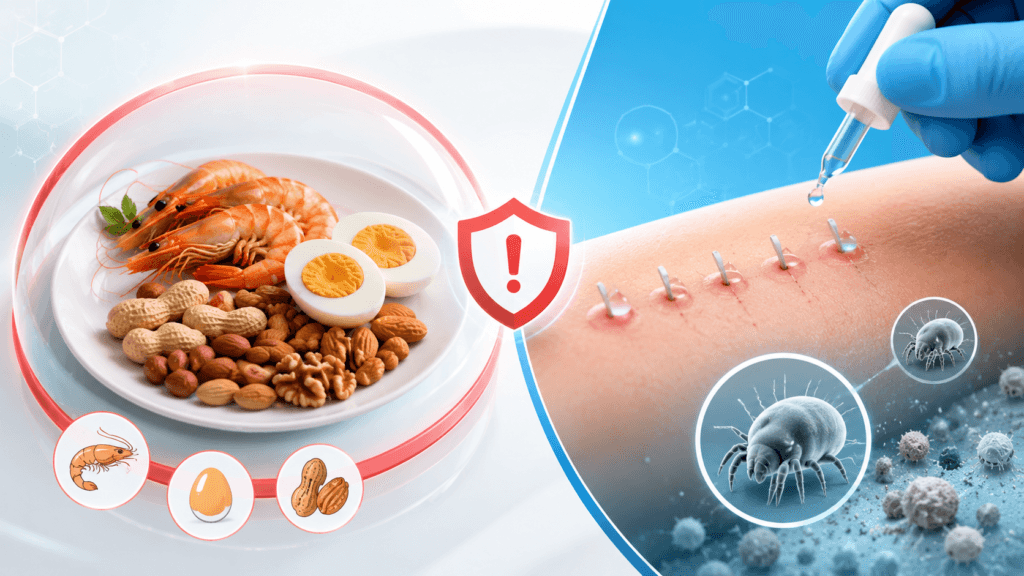
Food Allergy vs Skin Allergy: Symptoms, Causes, and How to Identify Your Triggers
It is a common scenario in clinical practice: a patient arrives at the clinic with severe, itchy red rashes on their skin and proudly announces, “Doctor, I have completely stopped eating prawns, eggs, and brinjal, but my skin allergy is still not going away!”
This is one of the biggest medical misconceptions among patients. People naturally assume that any reaction appearing on the skin must be triggered by something they ate. However, clinical immunology proves that Food Allergies and Skin Allergies are two entirely different medical pathways. While a food allergy can cause skin symptoms, nearly 80% of chronic skin allergic conditions are triggered by environmental or contact factors—not your diet.
Self-imposed dietary restrictions often lead to malnutrition without offering any real relief from the itch. To break free from this cycle, you need to understand the fundamental difference between food and skin allergies, how they manifest, and how modern diagnostic testing can pinpoint your exact triggers.
1. Understanding the Core Difference: Food Allergy vs. Skin Allergy
To understand why stopping certain foods isn’t solving your skin issues, we must look at how the body interacts with these distinct types of allergens.
+---------------------+-----------------------------------+-----------------------------------+
| Feature             | Food Allergy                      | Primary Skin Allergy              |
+---------------------+-----------------------------------+-----------------------------------+
| Primary Trigger     | Ingested proteins (Foods)         | Environmental / Physical Contact  |
+---------------------+-----------------------------------+-----------------------------------+
| Primary Path        | Digestive System ---> Bloodstream | Direct Contact / Inhalation       |
+---------------------+-----------------------------------+-----------------------------------+
| Key Symptoms        | Rash + Vomiting / Throat Swelling | Localized Rash, Hives, Eczema     |
+---------------------+-----------------------------------+-----------------------------------+
| Diagnostic Test     | Specific IgE / Skin Prick Test    | Patch Test / Skin Prick Test      |
+---------------------+-----------------------------------+-----------------------------------+
A. What is a True Food Allergy?
A food allergy occurs when your immune system mistakenly identifies a harmless protein in food as a dangerous invader. When you swallow that food, your digestive system absorbs the protein, triggering a systemic immune cascade.
Rapid Onset: True food allergic reactions usually occur within minutes to two hours of eating the offending food.
Multi-System Symptoms: A true food allergy rarely affects only the skin. It is typically accompanied by digestive issues (nausea, vomiting, severe stomach cramps), respiratory distress (wheezing, tightness in the chest), or swelling of the lips and tongue.
Anaphylaxis Risk: Severe food allergies can trigger anaphylaxis—a sudden, life-threatening drop in blood pressure and airway constriction requiring emergency care.
B. What is a Primary Skin Allergy?
A primary skin allergy occurs when your immune system reacts to external factors that touch your skin directly or microscopic allergens that you breathe in from the air.
Localized or Widespread Reaction: The skin may form raised wheals (hives/urticaria), severe localized redness, scaling, or intense itching.
Environmental & Contact Culprits: Instead of food, the actual culprits are usually dust mites, airborne pollens, fungal spores, harsh chemicals in cosmetics, metals like nickel, or dyes in clothing.
If you are suffering from chronic itching accompanied by respiratory issues like continuous sneezing or wheezing, consulting an expert specializing in asthma specialist kolkata permanent relief can help rule out interconnected airway hypersensitivity.
2. Common Symptoms: How They Reveal Themselves
While both conditions can make your skin itch, their clinical patterns differ significantly.
Symptoms of a Food-Induced Reaction
When an ingested allergen enters your system, it triggers an IgE-mediated response that travels through the bloodstream:
Acute Urticaria: Sudden appearance of hives or welt-like swelling across the body within two hours of eating.
Angioedema: Rapid, painful swelling of the lips, eyelids, tongue, or throat.
Gastrointestinal Distress: Sudden vomiting, abdominal cramps, or diarrhea immediately following a meal.
Systemic Distress: Dizziness, lightheadedness, or difficulty breathing.
Symptoms of Environmental & Contact Skin Allergies
Primary skin allergies manifest in specific ways based on the point of exposure or systemic sensitivity:
Contact Dermatitis: Severe itching, redness, or blistering strictly localized to areas touching specific items—such as a belt buckle, hair dye, or a newly used lotion.
Chronic Urticaria (Hives): Welts that come and go across different body parts over weeks or months, often linked to airborne allergens like dust mites rather than food.
Atopic Dermatitis (Eczema): Dry, scaly, intensely itchy patches found in the flexural areas of the body (elbow creases, behind knees) triggered by environmental dry air, sweat, or dust.
For patients experiencing persistent skin eruptions without any digestive distress, a consultation with a dedicated skin allergy specialist in Kolkata is crucial to evaluate non-dietary environmental factors.
3. The Myth of “Food Elimination” and Why It Fails
In many households, the moment someone develops a skin rash, they are immediately put on a strict diet: no fish, no brinjal, no eggs, no dairy, and no lentils.
Why Self-Imposed Diets Don’t Work
Wrong Target: If your hives are caused by microscopic dust mites living in your mattress or a nickel buckle on your trousers, stopping prawns will not stop the itching.
Nutritional Deficiencies: Unnecessary food restrictions lead to protein deficiency, weak immunity, and reduced quality of life, especially in growing children.
Delayed Clinical Diagnosis: By focusing entirely on diet, patients delay seeking proper immunological testing, allowing the underlying environmental allergy to become chronic.
Unless a clinical test or a medical specialist officially confirms a specific food allergy, arbitrarily restricting your diet is counterproductive.
4. Advanced Diagnostic Testing: Identifying Your Exact Triggers
Instead of guessing which food or cosmetic item is causing your skin to react, modern clinical allergy practice relies on precise diagnostic testing.
A. Modified Skin Prick Test (SPT)
The Skin Prick Test is the international gold standard for identifying both inhalant (dust mites, pollen) and food allergens.
How It Works: Minute, safe concentrations of standard allergen extracts are placed on your forearm, and a tiny microscopic prick is made through each drop.
The Result: Within 15 to 20 minutes, if you are allergic to a specific allergen, a small, itchy bump (wheal) appears. This test instantly reveals whether your skin reaction is linked to house dust or actual food proteins.
B. Patch Testing for Contact Allergies
If your skin reacts to items that physically touch your body (like artificial jewelry, perfumes, or hair dyes), a Patch Test is performed.
How It Works: Allergen panels are applied securely to your back and left undisturbed for 48 hours.
The Result: After 48 hours, the patches are removed and evaluated by a clinician to pinpoint the exact chemical or material causing localized contact dermatitis.
To get a comprehensive view of how diagnostic protocols help evaluate both systemic and localized allergies, explore our full guide on Allergy Treatment in Kolkata.
5. Clinical Management and Treatment Strategies
Effective treatment requires a structured, three-tiered approach focused on symptom relief, avoidance, and long-term immune modulation.
Step 1: Immediate Symptom Control $\rightarrow$ Non-sedating, second-generation antihistamines and targeted topical therapies are prescribed to calm active itching and skin inflammation safely.
Step 2: Targeted Avoidance $\rightarrow$ Based on test results, patients receive a clear action plan. If it is a true food allergy, the specific food is eliminated. If it is an environmental trigger, strategies like using anti-dust mite covers or fragrance-free products are adopted.
Step 3: Allergy Immunotherapy $\rightarrow$ For unavoidable environmental allergens like dust mites or pollen, desensitization therapy (immunotherapy) trains the immune system to stop overreacting, offering permanent clinical remission.
For individuals facing complex allergic conditions that involve both skin flare-ups and airway hypersensitivity, seeking care from the best allergy asthma specialist in Kolkata ensures an integrated, evidence-based treatment plan.
6. Practical Tips for Managing Sensitive Skin Daily
While undergoing diagnostic evaluation, these clinical daily care practices can help protect your skin barrier:
Moisturize Daily: Apply a plain, fragrance-free, hypoallergenic moisturizer immediately after bathing to lock in moisture and protect the skin barrier.
Choose Breathable Fabrics: Wear loose-fitting, 100% cotton clothing. Avoid synthetic materials or heavy wool directly touching sensitive skin.
Control Indoor Dust: Wash bedding in warm water weekly and reduce indoor carpets to minimize exposure to house dust mites.
Avoid Hot Showers: Hot water strips the skin’s natural oils, making it drier and far more susceptible to intense itching episodes.
For specialized clinical consultation, scheduling details, and diagnostic updates, you can review the official medical profile of Dr. Naren Pandey, Allergy Asthma Specialist in Kolkata.
🙋♂️ Frequently Asked Questions (FAQ)
Q1: Can a food allergy cause skin rashes without any stomach upset?
Ans: While it is possible for a mild food allergy to present primarily as hives, true food allergies usually cause additional symptoms like mild stomach cramps, lip swelling, or nausea. If you have chronic rashes that last for weeks without any digestive symptoms, an environmental or contact skin allergy is far more likely.
Q2: Is the Skin Prick Test painful or dangerous?
Ans: No. The Skin Prick Test uses microscopic lancets that barely scratch the surface layer of the skin. It causes no bleeding and very little discomfort—similar to a light mosquito tickle. It is completely safe when performed under expert clinical supervision.
Q3: Should I stop eating prawns and eggs if my skin starts itching?
Ans: No. You should never stop nutritious foods based on guesswork. Unless you notice a clear pattern of rashes appearing within two hours every single time you eat that specific food, consult an allergist for a diagnostic test before cutting it out of your diet.
Q4: What is the main cause of chronic hives if it isn’t food?
Ans: Chronic hives (lasting more than 6 weeks) are most commonly caused by inhalant allergens like house dust mites, airborne molds, pollen, underlying auto-immune responses, or physical triggers like friction and extreme temperatures.
Q5: How long does Allergy Immunotherapy take to show permanent results?
Ans: Allergy Immunotherapy is a disease-modifying treatment. Patients usually start noticing significant symptom reduction within 3 to 6 months, while full, long-term desensitization generally requires 3 to 5 years of structured therapy.
📞 Stop Guessing Your Triggers. Get Tested Today!
Are you tired of restricting your diet without getting relief from chronic skin itching? Stop masking the symptoms and identify your exact triggers with advanced Skin Prick Testing and Patch Testing under expert guidance.
Schedule a detailed Allergy Evaluation with Dr. Naren Pandey at the Sealdah/Moulali Clinic today!