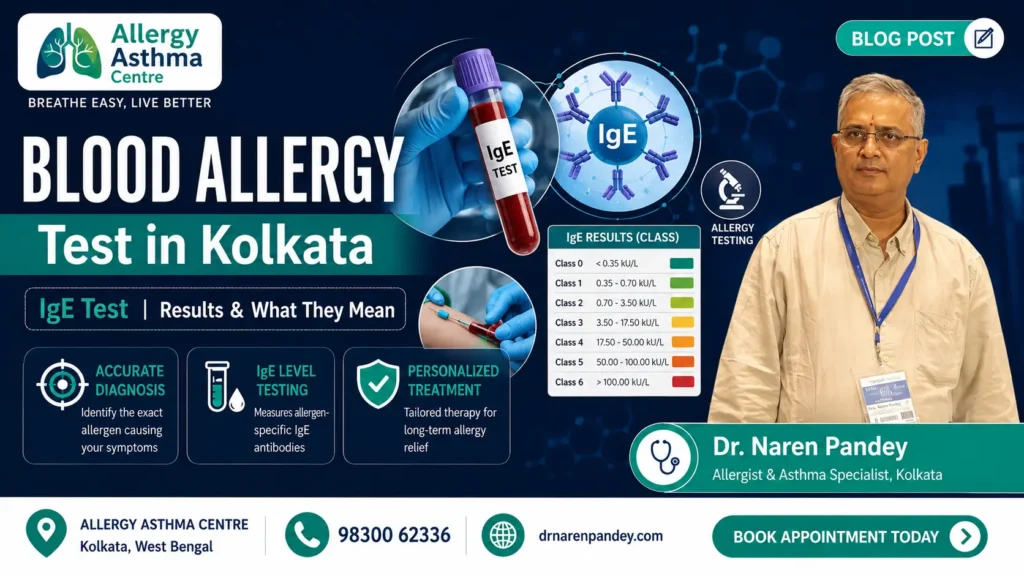
Blood Allergy Test in Kolkata: IgE Test, Results & What They Mean | Dr. Naren Pandey
By Dr. Naren Pandey | Allergist & Asthma Specialist, Kolkata
Have you been told you need a “blood allergy test” but don’t know what it involves? Or perhaps you have already received a blood allergy test report but are confused about what the numbers mean? You are not alone — blood allergy testing is one of the most misunderstood diagnostic tools in allergy medicine.
At the Allergy Asthma Centre, Dr. Naren Pandey uses blood allergy testing as part of a comprehensive diagnostic approach — helping patients in Kolkata identify their exact allergen and start the right treatment. This complete guide explains what a blood allergy test is, how it works, how to read the results, and what to do next.
What Is a Blood Allergy Test?
A blood allergy test — medically known as the Specific IgE (Immunoglobulin E) test or RAST test — measures the level of allergen-specific antibodies in your blood.
Here’s how it works:
When your immune system encounters an allergen it is sensitive to, it produces IgE antibodies specific to that allergen. The blood allergy test measures how much of these IgE antibodies are present in your blood for each tested allergen.
Higher IgE levels = greater sensitivity to that allergen
Unlike the Skin Prick Test where results appear on the skin, the blood allergy test is a laboratory test — a blood sample is drawn and sent to a lab for analysis.
Types of Blood Allergy Tests
1. Total IgE Test Measures the total amount of IgE antibodies in the blood — regardless of which allergen they are directed against.
- Normal total IgE: Less than 100 IU/mL in adults
- Elevated total IgE suggests allergic sensitisation but does not identify the specific allergen
- Used as a screening test — not diagnostic on its own
2. Specific IgE Test (Most Important) Measures IgE antibodies directed against specific allergens — dust mites, food proteins, pollen, mold, etc.
- This is the definitive blood allergy test
- Identifies exactly which allergen you are sensitive to
- Available as individual tests or panels (groups of allergens)
3. ALEX2 / Multiplex Allergy Test A newer, advanced blood test that can screen for 300+ allergens simultaneously from a single blood sample. Available at selected centres in Kolkata.
What Allergens Can Be Tested by Blood Allergy Test?
The Specific IgE blood test can detect sensitivity to virtually any allergen:
Inhalant Allergens:
- House dust mites (D. pteronyssinus, D. farinae)
- Cockroach allergens
- Cat and dog dander
- Mold spores (Aspergillus, Alternaria)
- Tree, grass, and weed pollen
Food Allergens (most common in Kolkata):
- Prawns and shellfish
- Fish — hilsa, rohu, catfish
- Cow’s milk and dairy products
- Eggs (white and yolk separately)
- Peanuts and tree nuts
- Wheat and gluten
- Soy
- Mustard — common in Bengali cooking
- Sesame
Other Allergens:
- Latex
- Insect venoms
- Drug allergens (penicillin, aspirin)
- Occupational allergens
How to Read Blood Allergy Test Results
Blood allergy test results are reported as IgE class levels:
| Class | IgE Level (kU/L) | Interpretation |
|---|---|---|
| Class 0 | < 0.35 | Negative — no allergy |
| Class 1 | 0.35–0.70 | Doubtful significance |
| Class 2 | 0.70–3.50 | Low sensitivity |
| Class 3 | 3.50–17.5 | Moderate sensitivity |
| Class 4 | 17.5–50 | High sensitivity |
| Class 5 | 50–100 | Very high sensitivity |
| Class 6 | > 100 | Extremely high sensitivity |
⚠️ Important: A positive blood test result does NOT always mean you are clinically allergic. Results must always be interpreted alongside your symptoms and clinical history by an experienced allergist like Dr. Naren Pandey.
Many laboratories report positive IgE results for dozens of allergens — leading to unnecessary dietary restrictions and anxiety. This is why expert interpretation is essential.
Blood Allergy Test vs Skin Prick Test: Which Should You Choose?
| Feature | Blood Allergy Test | Skin Prick Test |
|---|---|---|
| Method | Blood draw | Skin prick on forearm |
| Results | 1–3 days | 20 minutes |
| Accuracy | 75–85% | 85–95% |
| Cost | Higher | Lower |
| Antihistamines | Can test while on medication | Must stop 5–7 days before |
| Age | Any age | From 2 years |
| Eczema | Can test if skin affected | Not possible on affected skin |
| Multiple allergens | Limited by cost | 40+ simultaneously |
| Pain | Blood draw required | Light scratch only |
Dr. Naren Pandey’s recommendation:
- Skin Prick Test first — faster, cheaper, more accurate
- Blood test when skin testing is not possible — severe eczema, cannot stop antihistamines, infant under 2 years
Read our complete guide: Skin Prick Test in Kolkata
When Is a Blood Allergy Test Recommended?
Dr. Naren Pandey recommends blood allergy testing in these situations:
✅ Patient has severe eczema covering the test area — skin prick test not possible ✅ Patient cannot stop antihistamines — blood test can be done while on medication ✅ Infant under 2 years — less cooperative for skin testing ✅ Patient has dermographism — skin reacts to any pressure ✅ Confirming food allergy before oral food challenge ✅ Monitoring treatment response — IgE levels change with immunotherapy ✅ Patient prefers blood test over skin prick
How to Prepare for Blood Allergy Test
Before the test:
- No fasting required — eat normally
- No need to stop antihistamines or other medications
- Wear loose clothing with easy arm access
- Bring previous allergy reports if available
During the test:
- A small blood sample is drawn from a vein in the arm
- Takes only 2–3 minutes
- Minimal discomfort — same as any routine blood test
After the test:
- Resume normal activities immediately
- Results available in 1–3 days
- Dr. Naren Pandey reviews and explains results at follow-up consultation
Common Misconceptions About Blood Allergy Tests
Misconception 1: “High IgE means I’m definitely allergic” ❌ Not true. Elevated IgE indicates sensitisation — not necessarily clinical allergy. Many people have high IgE to foods they eat daily without any symptoms.
Misconception 2: “I need to avoid all foods that show positive” ❌ Not true. Only allergens that correlate with your symptoms need to be avoided. Unnecessary food restriction can lead to nutritional deficiencies — especially in children.
Misconception 3: “Blood test is more accurate than skin test” ❌ Not true. Skin Prick Test is generally more accurate and faster for most allergens.
Misconception 4: “A negative blood test means I have no allergy” ❌ Not entirely true. Some allergies — particularly non-IgE mediated reactions — will not show on blood tests.
What Happens After Your Blood Allergy Test?
Once Dr. Naren Pandey reviews your blood allergy test results:
Step 1 — Expert interpretation Results are matched with your symptoms and clinical history — identifying clinically relevant allergens.
Step 2 — Personalised avoidance plan Practical guidance on avoiding your confirmed allergens at home, work, and in your daily Bengali diet.
Step 3 — Targeted medication Specific antihistamines, nasal sprays, or inhalers based on your sensitisation pattern.
Step 4 — Immunotherapy assessment If your allergen is confirmed — immunotherapy (allergy vaccine) can provide permanent relief.
Read our complete guide: Immunotherapy in Kolkata
For complete blood allergy symptoms and treatment information, read: Blood Allergy Symptoms & Treatment
For a complete overview of all allergy tests: Best Allergy Test Center in Kolkata
Watch: Blood Allergy Test Explained by Dr. Naren Pandey
[Embed YouTube video: https://youtu.be/i3tazEgMixM]
Book Your Blood Allergy Test in Kolkata
Allergy Asthma Centre 2/2A Dr. Suresh Sarkar Road, Kolkata – 700014 📞 +91 98300 62336 🕘 Monday – Saturday: 9:00 AM – 7:00 PM 🌐 drnarenpandey.com
Get accurate blood allergy testing in Kolkata. Know your allergen. Start the right treatment.