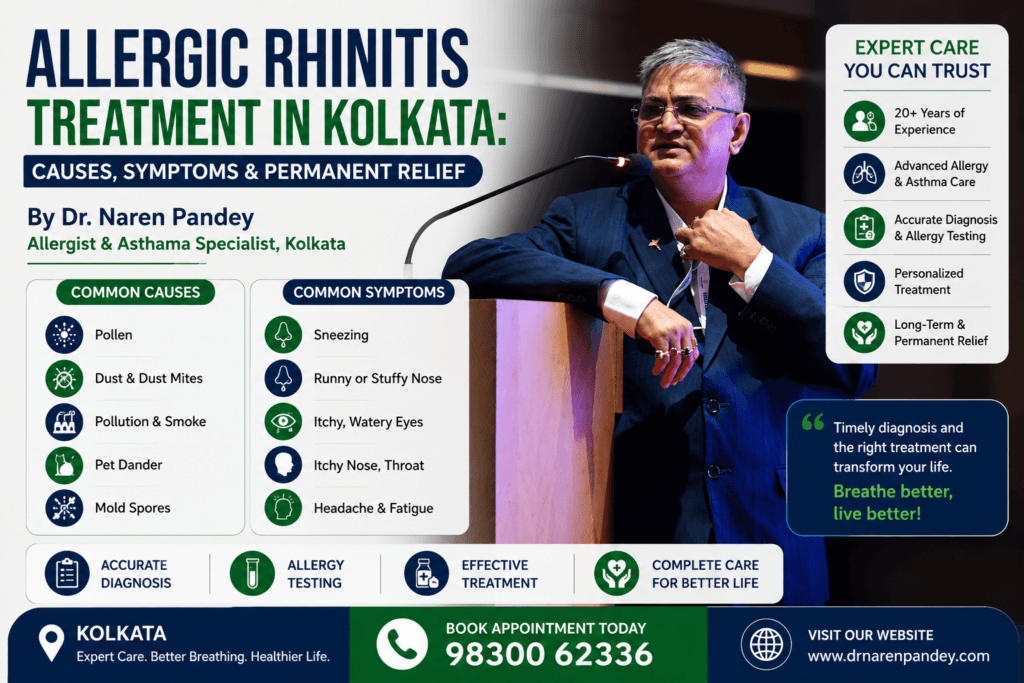
Allergic Rhinitis Treatment in Kolkata: Causes, Symptoms & Permanent Relief | Dr. Naren Pandey
By Dr. Naren Pandey | Allergist & Asthma Specialist, Kolkata
Do you sneeze repeatedly every morning as soon as you wake up? Is your nose constantly blocked or runny — especially indoors? Do your eyes itch and water for no apparent reason? If yes, you may be suffering from allergic rhinitis — one of the most common and most underdiagnosed allergic conditions affecting people in Kolkata.
At the Allergy Asthma Centre, Dr. Naren Pandey has successfully treated thousands of patients suffering from nasal allergy and allergic rhinitis in Kolkata. This complete guide explains what allergic rhinitis is, what causes it, and how to get permanent relief — not just temporary symptom control.
What Is Allergic Rhinitis?
Allergic rhinitis is an inflammation of the nasal passages caused by an allergic reaction to airborne substances like dust, pollen, or mold. When these allergens enter the nose of a sensitive person, the immune system releases histamine — triggering sneezing, runny nose, nasal congestion, and itchy eyes.
There are two main types:
Seasonal Allergic Rhinitis (Hay Fever) Triggered by pollen from trees, grasses, and weeds — typically worsens during spring and monsoon season in Kolkata.
Perennial (Year-round) Allergic Rhinitis Triggered by indoor allergens like house dust mites, cockroach droppings, mold, and pet dander. This is the most common type seen at our clinic in Kolkata — symptoms persist throughout the year.
Why Is Allergic Rhinitis So Common in Kolkata?
Kolkata’s environment creates ideal conditions for allergic rhinitis to thrive:
- High humidity — promotes house dust mite growth, the #1 cause of perennial rhinitis
- Air pollution — vehicle exhaust and industrial emissions irritate and sensitise nasal passages
- Seasonal pollen — spring months bring high pollen counts from roadside trees
- Monsoon mold — damp walls and flooding create ideal conditions for mold spore release
- Urban cockroaches — cockroach allergens are a major but overlooked rhinitis trigger in Kolkata homes
- Old housing — aging buildings accumulate years of dust mite colonies in carpets, mattresses, and walls
Common Causes of Allergic Rhinitis
Indoor Allergens (most common in Kolkata)
- House dust mites — thrive in mattresses, pillows, carpets, and curtains
- Cockroach droppings — highly allergenic, extremely common in urban homes
- Mold and fungal spores — especially during and after monsoon
- Pet dander — from cats, dogs, and birds
Outdoor Allergens
- Tree and grass pollen — highest during March–May in Kolkata
- Outdoor mold spores
- Air pollution particles
Occupational Allergens
- Flour and grain dust
- Chemical fumes and industrial dust
- Latex
Symptoms of Allergic Rhinitis
Allergic rhinitis symptoms are often mistaken for a repeated cold. Here is what to look for:
- Repeated sneezing — especially in the morning or after entering a dusty room
- Runny nose — thin, clear, watery discharge
- Blocked or stuffy nose — difficulty breathing through the nose
- Itchy nose, eyes, and throat
- Watery, red eyes (allergic conjunctivitis)
- Post-nasal drip — mucus dripping down the back of the throat causing cough
- Reduced sense of smell
- Fatigue and poor sleep due to nasal congestion
- Symptoms worse indoors — a key sign of dust mite allergy
If left untreated, allergic rhinitis can lead to:
- Sinusitis (sinus infection)
- Ear infections
- Sleep apnea
- Bronchial asthma — the most serious complication
Allergic Rhinitis vs. Common Cold: Know the Difference
| Feature | Allergic Rhinitis | Common Cold |
|---|---|---|
| Duration | Weeks to months | 7–10 days |
| Nasal discharge | Clear and watery | Thick and coloured |
| Fever | No | Sometimes |
| Itchy eyes/nose | Yes | Rarely |
| Sneezing | Repeated bursts | Occasional |
| Triggers | Allergens | Viral infection |
| Season | Year-round or seasonal | Mostly winter |
If your “cold” lasts more than 2 weeks or keeps coming back — it is almost certainly allergic rhinitis, not a cold.
How Is Allergic Rhinitis Diagnosed?
At the Allergy Asthma Centre, Dr. Naren Pandey uses a step-by-step diagnostic approach to identify the exact cause of your nasal allergy.
Clinical Evaluation A detailed history of your symptoms, triggers, lifestyle, and home environment helps Dr. Naren Pandey identify likely allergens before any test is done.
Skin Prick Test (SPT) Small amounts of common allergens (dust mites, pollen, mold, cockroach) are applied to the forearm skin. A raised wheal within 15–20 minutes confirms sensitivity to that allergen. This is the gold standard allergy test and is available in-house at our Kolkata clinic.
Specific IgE Blood Test Measures allergen-specific antibodies in the blood. Useful when skin testing is not possible — for example, in patients with severe eczema or those on antihistamines.
Nasal Endoscopy (if needed) To rule out nasal polyps or structural problems that may be contributing to nasal blockage.
Allergic Rhinitis Treatment in Kolkata
1. Allergen Avoidance
Once your trigger allergen is identified, our team creates a personalised avoidance plan. For dust mite allergy — the most common cause in Kolkata — this includes:
- Dust-mite-proof covers for mattresses and pillows
- Washing bedding weekly in hot water
- Using HEPA air purifiers in the bedroom
- Keeping indoor humidity below 50%
- Removing heavy curtains and carpets
2. Medications for Symptom Relief
Antihistamines Oral antihistamines reduce sneezing, itching, and runny nose. Second-generation antihistamines (non-drowsy) are preferred for daily use.
Nasal Corticosteroid Sprays The most effective medication for nasal symptoms — reduces inflammation, congestion, and post-nasal drip. Must be used regularly for best results.
Decongestants Provide short-term relief for blocked nose. Not recommended for long-term use.
Leukotriene Inhibitors Particularly useful when allergic rhinitis is accompanied by asthma.
Saline Nasal Irrigation Simple, safe, and effective — washing the nasal passages with saline solution removes allergens and reduces inflammation naturally.
3. Allergy Immunotherapy — The Only Permanent Treatment
For patients who want lasting relief — not just daily medication — allergy immunotherapy (allergy vaccine) is the answer.
Under Dr. Naren Pandey’s expert supervision, patients receive a structured course of allergen desensitisation:
- Gradually increasing doses of the identified allergen are administered
- The immune system learns to tolerate the allergen over time
- Nasal symptoms reduce significantly — often permanently
- Dependence on antihistamines and nasal sprays is dramatically reduced
- Available as subcutaneous injections or sublingual drops (under the tongue)
Immunotherapy is recommended when:
- Symptoms persist for more than 3 months a year
- Antihistamines and nasal sprays provide only partial relief
- The patient wants permanent relief without lifelong medication
- Rhinitis is complicated by asthma or sinusitis
- A child has allergic rhinitis — early treatment prevents asthma development
“Allergic rhinitis is not just a nuisance — it is a serious condition that can lead to asthma if left untreated. With proper allergy testing and immunotherapy, most of my patients achieve permanent relief and stop needing daily medication entirely.” — Dr. Naren Pandey, Allergy Asthma Centre, Kolkata
Can Allergic Rhinitis Lead to Asthma?
Yes — and this is one of the most critical reasons to treat allergic rhinitis early and properly.
Allergic rhinitis and asthma share the same underlying immune mechanism. Studies show that up to 40% of patients with allergic rhinitis eventually develop asthma if left untreated. This progression — from nasal allergy to asthma — is called the “united airway disease” concept.
At Allergy Asthma Centre, Dr. Naren Pandey treats both conditions together — stopping the progression from rhinitis to asthma before it begins.
For more information on asthma treatment, read our complete guide: Asthma Treatment in Kolkata
Practical Tips to Manage Allergic Rhinitis in Kolkata
- Morning routine — rinse your nose with saline spray before leaving the bedroom
- Keep windows closed during high pollen hours (early morning) and heavy traffic
- AC filters — clean every month; dirty filters circulate dust mite particles
- Bedroom first — dust mites live primarily in mattresses; use allergen-proof covers
- Avoid damp walls — fix leaks and use a dehumidifier during monsoon
- No heavy curtains — use washable blinds instead
- Get tested — knowing your exact allergen makes avoidance 10x more effective
When Should You See Dr. Naren Pandey?
Consult us at the Allergy Asthma Centre if:
- You have nasal symptoms that last more than 2 weeks
- Your symptoms return every season or every morning
- Antihistamines help but symptoms keep coming back
- You have developed a cough or wheeze along with nasal symptoms
- Your child has chronic nasal congestion or repeated colds
- You want a proper allergy test to identify your trigger
- You want permanent relief without lifelong medication
For a complete overview of allergy treatment in Kolkata, visit our Allergy Treatment in Kolkata page.
Watch: Allergic Rhinitis Explained by Dr. Naren Pandey
[Embed YouTube video: https://youtu.be/f4g6Kn47JlU]
Book Your Appointment
Allergy Asthma Centre 2/2A Dr. Suresh Sarkar Road, Kolkata – 700014 📞 +91 98300 62336 🕘 Monday – Saturday: 9:00 AM – 7:00 PM 🌐 drnarenpandey.com
Stop living with nasal allergy. Get tested, get treated, and breathe freely — permanently.