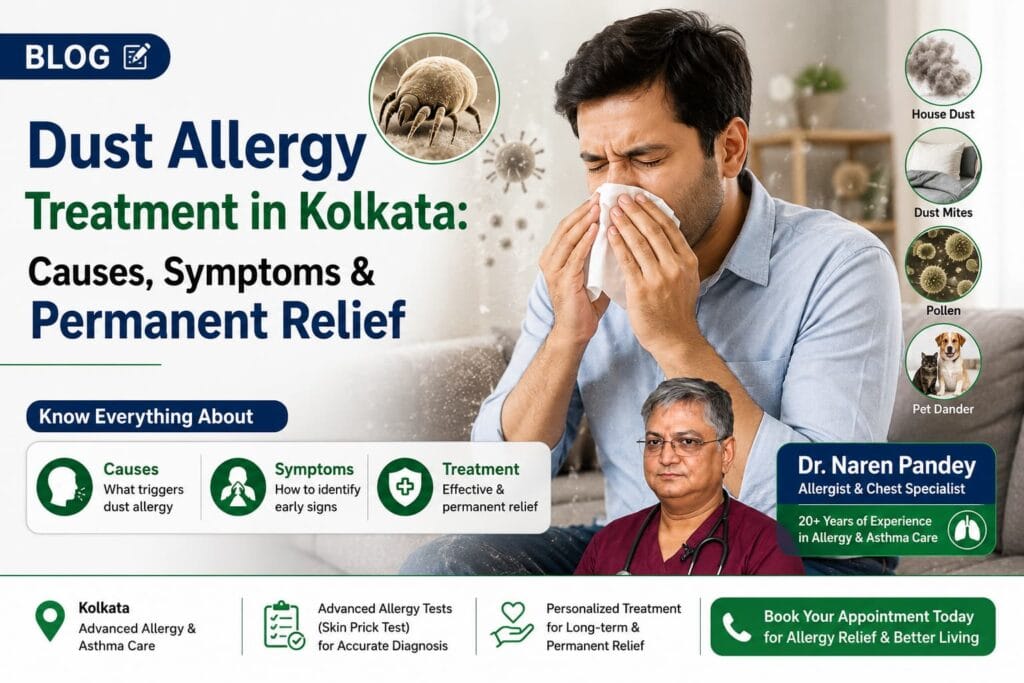
Dust Allergy Treatment in Kolkata: Causes, Symptoms & Permanent Relief | Dr. Naren Pandey
By Dr. Naren Pandey | Allergy & Asthma Specialist, Kolkata
Do you wake up every morning with sneezing, a runny nose, or itchy, watery eyes? Does your breathing feel heavy inside air-conditioned rooms or when you clean your house? You may be suffering from dust allergy — one of the most widespread yet most ignored allergic conditions affecting people in Kolkata.
At the Allergy Asthma Centre, Dr. Naren Pandey has treated thousands of patients suffering from dust allergy in Kolkata. This complete guide explains what causes dust allergy, how to recognise it, and how to treat it permanently — not just temporarily.
What Is Dust Allergy?
Dust allergy is an immune system reaction to microscopic particles found in household dust. The most common culprit is the house dust mite — a tiny organism invisible to the naked eye that thrives in mattresses, pillows, carpets, and curtains.
When a person with dust allergy breathes in these particles, the immune system identifies them as dangerous and releases chemicals like histamine, which cause allergic symptoms. Over time, repeated exposure can worsen the condition and even trigger bronchial asthma.
In Kolkata, dust allergy is particularly common because of the city’s high humidity, dense traffic pollution, and aging housing structures that trap dust mites and mold spores year-round.
Common Causes of Dust Allergy in Kolkata
While dust mites are the primary trigger, dust allergy can also be caused by several other allergens commonly found in Kolkata homes and surroundings:
House Dust Mites The most common cause of dust allergy worldwide. These microscopic creatures feed on dead skin cells and breed rapidly in humid conditions — making Kolkata’s climate ideal for their growth.
Cockroach Droppings A major allergen in urban Kolkata homes. Cockroach waste particles become airborne and trigger allergic reactions when inhaled.
Mold and Fungal Spores Kolkata’s high humidity during monsoon and post-monsoon months promotes mold growth in walls, bathrooms, and kitchens — releasing spores into the air.
Pet Dander Fur and skin particles from cats, dogs, and birds can mix with household dust and trigger reactions.
Pollen Seasonal pollen from trees and roadside plants adds to the allergen load, especially during spring and early summer in Kolkata.
Construction Dust & Air Pollution Kolkata’s ongoing construction activity generates significant dust, making outdoor exposure a trigger for many dust allergy sufferers.
Symptoms of Dust Allergy: How to Identify It
Dust allergy symptoms often mimic a common cold, which is why many patients in Kolkata suffer for years without a proper diagnosis. Here are the signs to watch for:
- Frequent sneezing, especially in the morning or after waking up
- Runny or blocked nose that is worse indoors
- Itchy, red, or watery eyes
- Coughing or a constant urge to clear the throat
- Wheezing or shortness of breath — a sign that dust allergy may be triggering asthma
- Itchy skin or rashes on exposure to dusty environments
- Fatigue and poor sleep due to nasal congestion at night
- Symptoms that worsen when cleaning the house or making the bed
If your symptoms are worst in the morning and improve when you go outdoors, dust mites inside your bedroom are likely the primary cause.
How Is Dust Allergy Diagnosed?
Accurate diagnosis is essential. Many patients arrive at our clinic after years of self-medicating with antihistamines without knowing exactly what they are allergic to.
Skin Prick Test (SPT) The gold standard allergy test. A small amount of dust mite extract and other common allergens is applied to the forearm skin with a tiny lancet. A raised wheal appears within 15–20 minutes if you are allergic. Dr. Naren Pandey performs this test in-house at the Allergy Asthma Centre, Kolkata.
Specific IgE Blood Test Measures allergen-specific antibodies in your blood. Particularly useful for patients who cannot undergo skin testing due to eczema, pregnancy, or ongoing antihistamine use.
Spirometry / Lung Function Test If dust allergy has triggered asthma, a spirometry test assesses how well your lungs are functioning. This helps Dr. Naren Pandey design the right treatment plan combining allergy and asthma management.
Dust Allergy Treatment in Kolkata: Your Options
1. Allergen Avoidance — First Step
Once your specific allergens are identified, our team provides a detailed avoidance plan tailored to your home and lifestyle in Kolkata. This includes:
- Using dust-mite-proof bed covers
- Washing bedding in hot water weekly
- Reducing indoor humidity with a dehumidifier
- Vacuuming with HEPA filters
- Removing heavy carpets and curtains that trap dust
2. Medications for Symptom Relief
- Antihistamines — reduce sneezing, itching, and runny nose
- Nasal corticosteroid sprays — most effective for nasal symptoms
- Leukotriene inhibitors — particularly useful when asthma is involved
- Decongestants — short-term relief for blocked nose
These medications manage symptoms but do not cure the allergy. Long-term dependence on antihistamines is not advisable.
3. Allergy Immunotherapy — The Only Permanent Treatment
Immunotherapy (allergy vaccine) is the most effective and the only treatment that addresses the root cause of dust allergy. Under Dr. Naren Pandey’s supervision, patients undergo a structured course of allergen desensitization:
- Small, gradually increasing doses of the identified allergen (dust mite extract) are administered
- The immune system learns to tolerate the allergen over time
- Symptoms reduce significantly — often permanently — after completing the course
- Available as subcutaneous (injection) immunotherapy or sublingual (under-tongue drops) immunotherapy
Immunotherapy is especially recommended for patients who:
- Have suffered from dust allergy for more than 2 years
- Need antihistamines daily to function normally
- Have developed asthma as a result of uncontrolled dust allergy
- Want a long-term, medicine-free solution
“Most of my patients come to me after years of taking tablets every day. Immunotherapy changes their life — they finally breathe freely without depending on medication.” — Dr. Naren Pandey, Allergy Asthma Centre, Kolkata
Dust Allergy vs. Common Cold: Key Differences
Many patients in Kolkata confuse dust allergy with a frequent cold. Here’s how to tell them apart:
| Feature | Dust Allergy | Common Cold |
|---|---|---|
| Duration | Weeks to months | 7–10 days |
| Fever | No | Sometimes |
| Itchy eyes/nose | Yes | Rarely |
| Sneezing pattern | Multiple in a row | Occasional |
| Triggers | Dust, indoors | Viral infection |
| Season | Year-round | Mostly winter |
If your “cold” lasts more than 2 weeks and comes back repeatedly, it is almost certainly an allergy — not a cold.
Can Dust Allergy Lead to Asthma?
Yes — and this is one of the most important reasons to treat dust allergy early and properly.
Untreated or poorly controlled dust allergy causes chronic inflammation in the airways. Over time, this narrows the bronchial tubes and leads to allergic asthma — characterised by wheezing, chest tightness, and breathlessness. In Kolkata, Dr. Naren Pandey regularly sees patients who developed asthma after years of ignoring their dust allergy symptoms.
Early diagnosis and immunotherapy can prevent this progression entirely.
Practical Tips to Reduce Dust Allergy at Home in Kolkata
- Bedroom first — dust mites live primarily in mattresses and pillows; encase them in allergen-proof covers
- Keep windows closed during heavy traffic hours — especially in areas like Entally, Park Street, and Sealdah
- Use an air purifier with a HEPA filter in your bedroom
- Avoid wall-to-wall carpets — use washable rugs instead
- Clean AC filters every month — dirty AC filters circulate dust mite particles through the room
- Dry laundry indoors only if necessary — wet clothes indoors increase humidity and mold growth
When Should You See Dr. Naren Pandey for Dust Allergy?
Consult Dr. Naren Pandey at the Allergy Asthma Centre if:
- You sneeze every morning and it has been going on for months
- You feel congested mostly indoors and better outdoors
- Antihistamines help temporarily but symptoms keep coming back
- Your child has developed a persistent cough or wheeze
- You suspect dust allergy but have never had a proper allergy test
- You want permanent relief, not just daily medication
For a complete overview of allergy treatment options in Kolkata, visit our Allergy Treatment in Kolkata page.
Watch: Dust Allergy Explained by Dr. Naren Pandey
[Embed YouTube video: https://youtu.be/f4g6Kn47JlU]
Book Your Appointment
Allergy Asthma Centre 2/2A Dr. Suresh Sarkar Road, Kolkata – 700014 📞 +91 98300 62336 🕘 Monday – Saturday: 9:00 AM – 7:00 PM 🌐 drnarenpandey.com
Stop managing your dust allergy — start treating it permanently.